What Is Cognitive Restructuring? Steps, Techniques and Examples
In short
Cognitive restructuring is a cognitive behavioral therapy technique for spotting a thought that's hurting you, testing it against the facts and replacing it with a more accurate one. The new thought has to fit what happened, taking in all the facts, the bad ones included. You can practice it in writing as part of your everyday routine.
A friend cancels your Saturday plans with a two-line text.
The moment you read it, a thought pops into your head: "he doesn't want to hang out with me."
You reason it out and you know you're exaggerating. Something probably came up, and you'll make plans for another day. But the thought sticks around, looping through your mind all afternoon and souring your whole Saturday.
Cognitive restructuring helps that thought stop getting to you. Your friend's text goes back to being just a text, and your Saturday doesn't get ruined by something that, deep down, you know isn't true.
What cognitive restructuring is
Cognitive restructuring is a cognitive behavioral therapy technique for catching a thought that's hurting you, examining it against the facts and replacing it with one that fits what happened better.
The starting idea is this: what upsets you is not so much what happens as what you tell yourself about it. Your friend's text is a small thing, and changing how you read it is one of the strategies for managing your emotions.
The technique comes from the cognitive therapy that psychiatrist Aaron Beck began describing in a 1963 paper on thinking in depression. You can practice it in writing, as part of your daily routine.
Restructuring is not positive thinking
The alternative thought doesn't have to be nicer: it has to be more accurate. It has to take all the facts into account, including the bad ones.
If you bombed an exam because you didn't study, "I bombed it and next time I need to start studying earlier" is accurate and useful. "I'm a mess and I'll never amount to anything" isn't, but "I'm sure I'll pass the next one" wouldn't be either: it's reassurance you don't believe.
A positive thought you don't believe is useless.
The steps of cognitive restructuring
On paper, the exercise follows these steps:
- Situation. Describe the event in one sentence, with no interpretation. "A friend canceled our Saturday plans with a two-line text," not "my friend doesn't want to see me."
- Emotion. Give it a specific name and an intensity from 0 to 10. Sadness, 6. If you're having trouble finding the right word, the emotion wheel helps you tell sadness apart from disappointment or anger.
- The thought, word for word. The exact phrase that went through your head: "he doesn't want to hang out with me," just as it showed up, not the calmer version you'd build thinking it over.
- Thinking trap. Which trap does it look most like? Is it mind reading, catastrophizing, a "should" statement? If you're torn between two, write down the first one you thought of.
- Test it. With the techniques in the next section: Socratic questions, evidence for and against, or whichever fits best.
- Alternative thought. More accurate than the original, including the facts you had left out.
- Rate the emotion again. If it went down even a little (from a 6 to a 4, say), the exercise worked. If it didn't, try another technique on the same thought.
There's a three-word trick to remember it: catch it, check it, change it. You catch the thought when it shows up, you check it against the facts and you replace it with a version you can believe.
The first three steps are exactly the ones in an emotional journal: situation, emotion and thought. What restructuring adds is the examination of the thought. You'll find the complete thought record in the guide to cognitive distortions, which is the best place to start if you can't tell the traps apart yet.
Cognitive restructuring techniques
You don't need to use them all. These are the main ones.
Socratic questions
Socratic questioning means examining the thought with questions, instead of arguing with it.
You can use them as they are:
- What evidence do I have for this thought? What about against it?
- What other explanation could there be for what happened?
- What most likely happened?
- What's the worst that could happen, and could I handle it?
- How will I see this in a year?
- Am I mixing up how I feel with how things are?
For thoughts that jump straight to the worst case, there's also a specific technique called decatastrophizing.
A study with 55 adults in cognitive therapy for depression found that, in the sessions where the therapist asked more Socratic questions, depression improved more over the following week. It's an association observed in therapy, with a professional in the room.
For example, take "my friend canceled because he doesn't want to hang out with me." What evidence do I have? A short text.
What other explanation could there be? He's worn out from the week, or something came up.
Evidence for and against
Treat the thought as a hypothesis, not as a fact. A hypothesis needs evidence, and if the evidence isn't there, you revise it.
Say your partner is quiet all Sunday and you think "being around me is a chore." Evidence for: he was quiet. Evidence against: on Saturday you had a great time talking about everything, he made your coffee like he always does and he hugged you goodbye.
The alternative thought that comes out of that: "he had a packed weekend; if something is weighing on him, he'll bring it up."
What would you tell a friend
We think more clearly about other people's problems than about our own.

In psychology this is called Solomon's paradox, after the wise king who gave good advice to others and never applied it to himself. In three experiments with 693 people, people reasoned more wisely about someone else's relationship problems than about their own, and the difference disappeared when they were asked to think about their own problem from a distance, as if watching it from the outside.
The technique puts that effect to work: write the problem the way you'd tell it to a friend, and then write what you'd answer. Imagine a friend tells you she left dinner without saying goodbye and now thinks "she's mad at me."
What you'd answer her is: "maybe she wasn't feeling well; ask her tomorrow and you'll stop wondering."
That answer, almost always, is the alternative thought you wouldn't allow yourself.
What believing the thought costs you and what it gives you
Sometimes the thought survives the evidence: however hard you look, you find nothing against it. This is when you switch questions: even if it were true, what does believing it cost you?
Take the thought "I'll look stupid if I ask a question in class." Believing it costs you staying confused, not understanding the material and failing because you didn't ask.
Once you see the price you pay for holding on to it, it gets easier to stop feeding it, even if you can't take it apart completely.
The downward arrow
The downward arrow goes after the belief underneath the thought. It works by asking yourself, over and over, "and if that were true, what would it mean about me?"
For example, take "my partner hasn't said anything about what I did this weekend." And if that were true? That he doesn't value what I do.
And if that were true? That I matter less to him than I used to.
And if that were true? That I'm not good enough.
That last sentence, "I'm not good enough," is the core belief. When you recognize the one at the bottom, the ones on top lose part of their grip, because you understand where they come from.
It works well for the thoughts that keep coming back, the ones you've questioned a thousand times and that still show up.
Testing it in real life
Many automatic thoughts are predictions, and predictions can be tested. The technique turns the thought into a small experiment: if you think "if I ask her for help, my friend will think I'm a bother," ask her for something small and write down what happens.

You design a simple experiment: something concrete, with low stakes, where you can measure the result. "This week I'll ask my friend to come with me on an errand and I'll note what she says." Then you compare what your head predicted with what happened.
One experience of your own that contradicts the thought usually convinces you more than any argument.
Which technique to use for each thinking trap
Each trap responds better to a specific technique. These are the ones MindLogs detects, paired with the one that works best against them:
- Catastrophizing: Socratic questions. They force you to look at the whole scenario, worst case included, and check whether you could handle it.
- All-or-nothing thinking: what believing the thought costs you and what it gives you. Seeing how much it costs to hold on to "perfect or disaster" opens the door to the middle ground.
- Mind reading: testing it in real life. What someone else thinks isn't something you can deduce: you ask, or you wait to see what they do.
- Mental filter: evidence for and against. The against list is the record of everything the filter left out.
- Personalization: Socratic questions. Looking for other possible explanations puts the responsibility back where it belongs.
- Overgeneralization: evidence for and against. An "always" collapses as soon as you write down the facts that don't fit it.
- "Should" statements: what would you tell a friend. You'd never hold a friend to the rule you hold yourself to, and the distance gives it away.
- Emotional reasoning: the Socratic question about mixing up how you feel with how things are. It separates what you feel from what you can prove.
- Labeling: the downward arrow. "I'm a failure" almost always hides a core belief, and this technique is built to find it.
If you don't know what trap is behind your thought, start with the Socratic questions: they work for all of them.
One thought, three techniques
In the Monday meeting, your boss asks for ideas. You offer one, and she moves on to the next without a word about it. The thought that shows up: "that was a ridiculous idea, she doesn't take me seriously anymore."
Emotion before: embarrassment, 7.
With the Socratic questions, you ask what other explanation there could be and how you'll see this in a year. The alternative thought comes out: "she didn't comment on my idea; maybe she was in a hurry," and the embarrassment drops to a 4.
With the evidence for and against, you note that in the last meeting she approved your proposal and that two coworkers told you it helped them. The alternative thought: "I don't know what she thought of my idea, and my work from the past few weeks is right there." Embarrassment after: 4.
With what would you tell a friend, you write what you'd say to them: "if she had a problem with your work, she'd tell you, like she always has." The alternative thought: "she could have missed it for a thousand reasons that have nothing to do with you; if it's bothering you, ask her." Embarrassment after: 3.
All three get to similar places by different routes. Stick with the one that comes most naturally, because that's the one you'll practice.
When you know it, but you don't believe it
The alternative thought convinces your head, but your body still feels the same. You read the new sentence and the anxiety doesn't budge.
That's part of the process: what you tell yourself changes before what you feel. These things help:
- Rate how much you believe each thought, from 0 to 100. Don't expect the old one to disappear: maybe it goes from a 90 to a 60. That drop is already progress.
- Make the alternative thought more modest. If "it's fine" isn't believable, try "it may not be as bad as it seems." A thought you believe at 70 is worth more than a perfect one you believe at 20.
- Repeat the exercise with the same thought when it comes back. Each round gives the new version more weight.
- Move on to testing it in real life. An experience that contradicts the thought can move that number more than any argument.
What research says about cognitive restructuring
What we know about cognitive restructuring comes mostly from therapy. A review pooling four studies with 353 patients in therapy found that the more cognitive restructuring there was in the sessions, the better the therapy outcomes. It's an association found in therapy, and the authors themselves call for more research.
For depression there's also a meta-analysis of 45 trials with 3,382 adults that compared three ways of working, all delivered face to face by a therapist: cognitive restructuring alone, behavioral activation (working on what you do) and full cognitive behavioral therapy. It found no differences in effectiveness among the three, and all three worked better than usual care and a waitlist.
In plain terms: with a therapist, working on thoughts alone produced the same result as full therapy. None of this shows that an exercise on your own cures anything; what it does suggest is that examining thoughts, in that setting with a professional, is work that pays off.
Common mistakes and when to get help
These are the most common stumbles when you're starting out:
- Doing it only in your head. In your head the thought races by and slips away; on paper you can look at it up close.
- Waiting until the emotion is at a 9. With the emotion that high, examining anything is nearly impossible. At first, practice with thoughts at a 4 or a 5, the small ones, and save the big ones for later.
- Demanding absolute certainty. The goal is a more accurate version of the thought, and for that it's enough to challenge the parts that don't hold up. If you demand definitive proof, you'll never finish the exercise.
- Turning it into endless rumination. If you've been at it a while and you're not getting anywhere, stop. The exercise ends with a thought written down and an emotion rated again.
- Arguing with the thought instead of examining it. Asking it what evidence it has gets you further than telling it it's wrong.
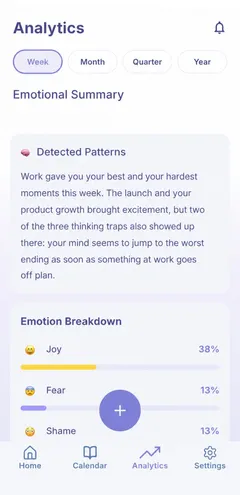
MindLogs is built for exactly this habit. The therapy journal app structures each entry in seven steps, where you can write or dictate. When you finish, it points out the thinking trap behind what you wrote and suggests looking at it from a different angle.
Everything stays encrypted on your phone.
And keep in mind that this helps you know yourself better; it isn't a treatment. If what you feel keeps overwhelming you or gets in the way of your daily life, talk to a mental health professional.
Conclusion
Cognitive restructuring means examining an automatic thought against the facts and replacing it with one that fits what happened better. The 3 C's sum it up: catch it, check it, change it.
The goal is accurate thinking. An alternative thought counts when you believe it, and sometimes the accurate version is still uncomfortable.
You learn it by practicing, in writing and with small thoughts. Take the one that messed up your day, name the emotion and ask it one Socratic question: that's a start.
Frequently asked questions
What is an example of cognitive restructuring?
A neighbor doesn't wave back when you say hi, and the thought "they don't like me" shows up. When you ask yourself what evidence you have, you remember they were wearing sunglasses, they seemed to be in a hurry and they've greeted you normally other times. The alternative thought: "maybe they didn't see me, and if they don't like me I won't know until I check." The thought changes because you checked it against the facts, not because you repeated something reassuring to yourself.
What are the 3 C's of cognitive restructuring?
The 3 C's are catch it, check it and change it, and they sum up the exercise in three steps. Catching the thought means noticing it has appeared and writing it down exactly as it came. Checking it means testing it with questions and the evidence you have. Changing it means replacing it with a version that fits the facts, and rating the emotion again to see whether it went down.
Is cognitive restructuring the same as cognitive reframing?
They are similar, but not identical. Cognitive reframing is often used as a near-synonym: reframing means looking at the same thing from a different frame or perspective. Cognitive restructuring adds the step of testing the thought against evidence before changing it: you check whether what you think holds up against what happened, and only then do you reword it.
What is the difference between cognitive restructuring and CBT?
Cognitive restructuring is one of the techniques of cognitive behavioral therapy (CBT), not the therapy itself. CBT also works on what you do (for example, through behavioral activation), not only on what you think. You can practice cognitive restructuring on your own as a writing exercise, while therapy is applied by a professional to your specific case.
Can you do cognitive restructuring on your own?
Yes, you can practice it on your own as a writing exercise with everyday thoughts: write down the situation, the emotion, the thought word for word and then test it. It is a wellness and self-knowledge tool, not a replacement for professional care. If what you feel keeps overwhelming you or gets in the way of your daily life, talk to a mental health professional.
Pau Forner
Author and entrepreneur specializing in digital marketing and emotional intelligence. Author of Dirige Tu Vida (Editorial Planeta), a bestselling book on social and emotional skills.