How to Stop Overthinking: 7 Techniques to Break the Loop
In short
Overthinking means turning the same thought over and over without reaching a decision or an action. It can look back at the past (rumination) or ahead at the future (worry). You break it by changing the kind of question you ask yourself and getting the loop out of your head.
You text someone mid-morning.
Hours go by and they don't reply. By noon you've reread your message three times, and by the afternoon you're wondering whether it came off rude or whether you said something you shouldn't have. You even start rehearsing what you'll say tomorrow.
Meanwhile, your work sits half done because you can't focus. And at night, once you're in bed, your mind keeps turning it over and sleep won't come.
Learning to stop overthinking helps you break that loop, finish what you started and get to bedtime with a quieter mind.
What overthinking is
Overthinking means turning the same thought over and over without reaching a decision or an action. Psychology studies it as rumination, which is the technical name for that kind of thinking that goes nowhere.
It isn't thinking a lot: it's thinking in circles, because you end up back where you started every few minutes without adding anything new.
Thinking hard about a problem can be useful: you weigh options, compare them and decide. Overthinking looks like that, but it leaves you with no conclusion and no next step.
And it costs you: of all the ways to respond to an emotion, rumination is one of the most likely to drag you down when you're trying to manage your emotions. The longer you stay inside the loop, the worse you feel.
Rumination and worry: the two sides of overthinking
Overthinking points in two directions. Rumination looks back at the past: you replay what you said in a meeting and ask yourself why you answered that way. Worry looks ahead at the future: you imagine the difficult conversation you keep putting off with your brother and think through everything that could go wrong.
They work the same way, as a loop, and the techniques below work for both. Each one notes whether it fits rumination or worry better.
Overthinking isn't the same as having an intrusive thought, either. An intrusive thought arrives out of nowhere, without you looking for it, and feels foreign; the overthinking loop starts with a question you ask yourself.
Thinking is not the same as going in circles
The difference between thinking and overthinking is the kind of question you ask yourself. Abstract questions ("why does this always happen to me?", "what does this say about me?") have no answer you can check, so they keep you inside the loop. Concrete ones ("what exactly happened?", "what can I do today?") lead somewhere.
Research has measured it. In a study with 40 patients with depression and 40 people without depression, thinking about your own problems in concrete terms (what happened, how and in what order) improved the patients' ability to solve problems, compared with thinking about them in abstract terms (why and what it means). Thinking through a problem concretely (what happened and what you can do) is what helps you solve it.
Here's a quick test for telling which one you're in: after 10 minutes on a topic, ask yourself whether you're any closer to doing something or deciding something. If you're not closer to either, you're just looping.
Signs of overthinking
These signs show up in everyday life, and having some of them is normal: it means the habit is there and that you can work on it.
- You replay conversations that already happened. You search for the line you said and what you should have said instead.
- You rehearse conversations that haven't happened yet. You prepare a scene that may never take place.
- You ask several people for their opinion and still can't decide. Each new answer adds doubts instead of closing them.
- You reread a message before sending it. You change it, reread it, hit send and still aren't sure.
- You can't sleep because your mind won't stop. You get into bed and the same topic starts up again.
- You reach the end of the day exhausted without having done anything demanding. Dwelling on things is what tires you.
- You notice tension in your body. A clenched jaw, stiff shoulders or a tight stomach with no physical cause.
If you recognize yourself in several of these at once, the techniques below are the next step.
Why we overthink
If dwelling on things leads nowhere, the logical move would be to let it go. In practice, almost nobody does, and there are three reasons for that.
The first: it feels useful. You get the sense that you're solving the problem, so you keep at it even after an hour without a single new idea.
The second: it gives a sense of control. Replaying scenarios when you don't know what's coming makes it feel like you're preparing for everything.
The third: you find uncertainty hard to sit with. Any answer, even the worst one, is easier to live with than an open question, and you keep looping to try to close it.
Thinking traps (the biases that show up on their own in your thoughts) feed the loop: a "this always happens to me" or a "they must have thought something bad about me" makes the thought feel like a conclusion when it isn't one. They're all cataloged in the guide to thinking traps.
And all that seeming analysis leaves you worse off than just distracting yourself for a while. Across three studies with people in a low mood, those who ruminated about how they felt read situations more negatively, felt more pessimistic about their future and came up with worse solutions to problems with other people. Those who distracted themselves were as optimistic and solved the problems just as well as people in a normal mood.
Decisions work the same way. In an experiment on rumination and indecision, people in a low mood who ruminated found their decisions harder and trusted what they chose less than those who distracted themselves. What looks like analysis leaves you worse off than before.
How to stop overthinking: 7 techniques
You can combine them, and all they need to do is cut the loop and return you to what you were doing.
Name the loop
The first step is noticing you're inside it. While you're thinking, you don't see it; the moment you point at it, you gain a little distance.
When you catch it, tell yourself in one sentence: "I'm going in circles again." Don't argue with it or analyze it yet: just name it and note what it's about. For example, you jot down the studying you've been putting off ("I can't stop thinking about the exam material for next month") and leave it written down without judging yourself for it.
With the loop named, the next step is picking one of the techniques below instead of going over it again. It works for rumination and for worry.
Swap the "why" for "what can I do"
This is the change of question that separates thinking from overthinking. Abstract questions have no answer, so replace them with a concrete one that does.
For example: "why is public speaking so hard for me?" becomes "what can I do today so Thursday's presentation goes better?" The first one produces anxiety and a loop; the second one produces a list and a plan.
Do it out loud or in writing, because changing the format also helps cut the repetition. It works for both directions of overthinking.
Give worry an appointment
If what you overthink is mostly about the future, give worry a slot of its own: pick about 15 minutes a day, always at the same time and in the same place, to do your worrying.
When a worry shows up outside that window, write it down in one sentence and tell yourself you'll get to it during your worry time. For example: "I'm worried about the dentist; I'll deal with it tomorrow at 7:30 in the kitchen, after the kids are in bed."
A trial with 186 adults over two weeks found that those who postponed worry with a concrete plan ("when a worry shows up, I write it down and leave it for 6 o'clock on the couch") worried about 15 minutes less per day than those who postponed it without a plan. There's an important catch: it didn't improve sleep, so for nighttime you need other tools, the ones in the nighttime section below.
Get it out of your head on paper
In your head you go over it in bits and pieces, a little differently each time. When you write it down, you see the whole thing at once and you can look at what's actually there.
Grab paper or your phone and write down what you can't stop thinking about, in any order, without editing: what happened, what you fear and what you tell yourself. An emotional journal gives you the structure to do it every day, and rereading it shows you which topics keep coming back.

Say you've spent weeks going back and forth on a big expense you need to decide: write down the amount, why it's holding you back and what options you see. Often, by the time you reach the last line, it doesn't feel as urgent as it did when you started. It works for rumination and for worry.
Test the thought that feeds the loop
Often the loop spins around one thought you keep telling yourself: "I made a fool of myself," "they're going to fire me," "they don't like me." As long as that line stays intact, the loop restarts.
Examine it with questions: what evidence do I have for and against it? What other explanation could there be for what happened? What would I tell a friend in my place?
If you write the answers down, the line holding the loop up loses its grip. If your friend didn't reply to your invitation, for example, the evidence against (she's been saying for months that she wants to get together) loosens the "she doesn't care about me anymore."
This technique is cognitive restructuring, and its guide walks through it step by step. When the loop jumps to the worst possible scenario ("what if I lose everything"), that has a name too: catastrophizing.
Move your body or your hands
When the loop has been spinning for half an hour, arguing with it rarely works. What does cut it is an activity that demands your attention: a brisk walk, cooking, tidying a room or calling someone on the phone.
Use it to cut the loop and come back to the topic later, with a cooler head. Maybe you've spent the whole afternoon replaying the last argument with your mom: take the dog out or start cooking, and pick the topic back up at night, when it isn't so fresh.
In an experiment with 60 college students who were put into a low mood, distracting themselves improved their mood compared with ruminating, and ruminating increased their negative beliefs. It works better for rumination.
Take the first small step
Sometimes the loop spins because a decision or a task is pending, and your mind won't let it go until it's solved. What solves it is an action, however small.
Pick the smallest possible step and do it now. If you've spent three days putting off an email you haven't written, write just the first sentence. If a decision has you stuck, find the one piece of information you're missing and look it up.
Once the first step is done, the task has started, and it's no longer just hanging over you.
What to do when you overthink at night
At night there's nothing to distract you and no tasks to occupy you, and with the day's fatigue it's harder to cut the thought off.

A few adjustments help:
- Set your worry appointment in the afternoon, far from bedtime. If you save it for 11 p.m., you're training your mind to worry in the very spot where you're trying to sleep.
- Write a to-do list if tomorrow's to-dos start piling up in your head. Keep it concrete: what needs doing and nothing else.
- If you've been awake a long while, get up. Do something quiet in low light and come back when you're sleepy, instead of fighting it in bed.
There's a striking finding about the to-do list. In a study in a sleep lab with 57 young adults, those who spent five minutes before bed writing a to-do list for the coming days fell asleep faster than those who wrote about what they had already done. And the more specific the list, the faster they fell asleep.
What research says about rumination
Most of what psychology has learned about overthinking comes from studies on rumination, and the findings point the same way. Ruminating about how you feel colors how you read what happens and how you solve problems. With decisions, it's more of the same: rumination makes them feel harder and makes you trust what you chose less.
Distracting yourself for a while improves your mood, and thinking through problems concretely, instead of abstractly, improves your ability to solve them. Postponing worry with a concrete plan cuts the minutes a day you spend worried, and writing a specific to-do list before bed helps you fall asleep sooner.
There is also a therapy built around rumination. In a trial with 42 people with persistent depression, adding up to 12 sessions of a cognitive behavioral therapy focused on rumination to usual care improved outcomes, and the improvement came through ruminating less. It's work done with a therapist, and it points to something useful: rumination can be reduced.
When to get help
These techniques are wellness tools for small, everyday loops, and they don't replace treatment. If the loop keeps taking away your sleep, keeps you from living your life normally or comes with a very low mood, talk to a mental health professional.
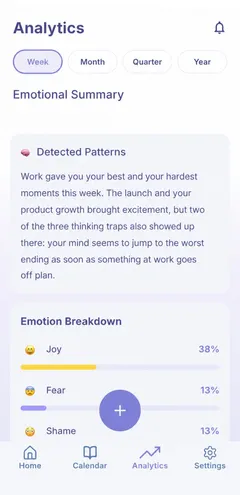
One habit that helps day to day is writing down what you can't stop thinking about. MindLogs is a therapy journal app that walks you through each entry in seven steps, and you can write or dictate each step.
When you finish, the app flags the thinking trap that may be underneath the thought and suggests another angle to look at it from. Everything you write stays encrypted on your phone.
Conclusion
Overthinking means turning the same thing over without reaching a decision or an action: pointed at the past it's rumination, and pointed at the future, worry. You can tell it apart from useful thinking with a simple test: after a while, are you any closer to doing something or deciding something?
The way out doesn't come from thinking more. It comes from changing the kind of question you ask yourself (from abstract to concrete) and from getting the loop out of your head, with the worry appointment, the small first step or an activity that demands your attention.
Practice first on small loops. Take the topic you can't stop thinking about today, name the loop and turn its question into one you can actually answer.
Frequently asked questions
What happens when you overthink?
You go over the same topic again and again without moving forward, and you never get to a decision or an action. Your decisions also get harder: the more you dwell, the less you trust what you finally choose. And you end up worn out, as if you had spent hours working on something that got you nowhere.
Why do I overthink?
Overthinking feels like problem solving, and that is exactly why it sticks: it gives you a sense of control when things are uncertain. Thinking traps such as "this always happens to me" feed the loop by making the thought feel like a conclusion. It keeps running because any answer, even a bad one, is easier to live with than an open question.
What is overthinking called?
In psychology it goes by two names, depending on where it points. When you look back at the past (something you said or something someone did) it is called rumination, and when you look ahead at what could go wrong it is called worry. In everyday language people usually just call it overthinking.
What is overthinking in a relationship?
It is replaying a short text, a silence or a gesture from your partner and reading into it: "they replied with two words, something is wrong." It often lasts for hours and rarely ends in a conclusion. Asking directly works better than continuing to guess what they meant, because the other person's answer usually cuts the loop.
Is overthinking a form of anxiety?
They are not the same, although they feed each other: overthinking can raise your anxiety, and anxiety makes you think more about what worries you. Overthinking is a thinking pattern, not a mental health condition. If it keeps overwhelming you or gets in the way of your daily life, talk to a mental health professional.
Pau Forner
Author and entrepreneur specializing in digital marketing and emotional intelligence. Author of Dirige Tu Vida (Editorial Planeta), a bestselling book on social and emotional skills.