
What Is Journaling and How Do You Do It?
In short
Journaling is writing regularly about your experiences, thoughts and feelings, with the goal of understanding yourself, not just keeping a record of the day. A diary tells you what happened; journaling asks what it means to you. Many studies have measured a positive effect from writing this way, especially when you move from venting to trying to understand what happened.
What journaling is
Journaling means sitting down to write about what's going on in your life so you can understand it better. All you need is a notebook or your phone and a few minutes.
Most people use "journal" and "diary" interchangeably. When people talk about journaling, though, they usually mean something more specific: writing to understand yourself.
A diary tells you what happened: "I argued with my sister today." A journal entry goes further: "I argued with my sister and I came away feeling like I'm always the one who gives in." The event is the same; the second version tells you something about yourself that the first one doesn't.
Journaling vs. diary vs. bullet journal
Because journaling, a diary and a bullet journal can all live in the same kind of notebook, it is easy to think they are the same. They are not.
- Diary. It records the day: where you went, who you were with and what happened. Its job is to help you remember.
- Bullet journal. A planning system with lists, tasks and calendars. It may have a reflection page here and there, but its purpose is to keep you organized.
- Journaling. Writing to understand yourself. The event is the starting point, and you look for what it means to you.
What turns writing in a notebook into journaling is the question you write with. You can fill 20 notebooks without ever journaling, or journal in the notes app on your phone.
Types of journaling
You don't have to pick one and stick with it forever: you can combine them, and none of them is best for everything. Each one fits a different moment.
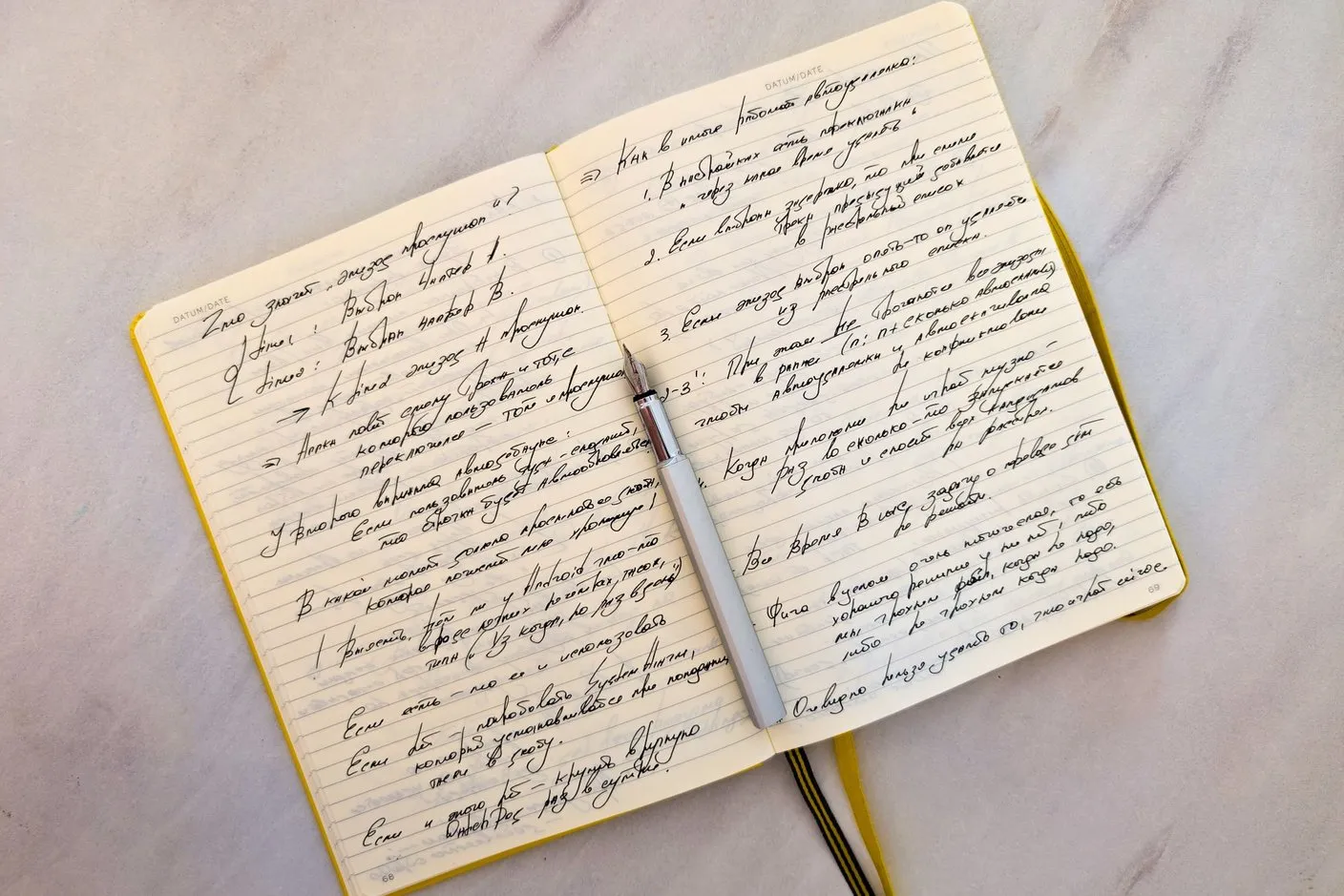
Free writing or morning pages
Writing without stopping or editing, and putting down whatever comes to mind. There is no topic, no structure and no filter: if halfway down the page you jump from what is worrying you to your grocery list, keep writing.
The best-known version is Julia Cameron's morning pages, described in her book The Artist's Way: three handwritten pages first thing in the morning, written as a stream of consciousness. They help you clear your head before the day starts, without analyzing anything.
It works when your head is full and you struggle to get going. The risk is going around in circles for weeks without asking yourself anything new.
Expressive writing
You write about something that upset you, what you felt and what you thought, and try to make sense of it. It is the core exercise of therapeutic writing.
In the classic expressive writing format, you write about something difficult in sessions of 15 to 20 minutes, usually over three to five days.
It is a good option when there is a specific event you can't stop thinking about: an argument, a decision, a loss or a change. For ordinary days with no fires to put out, other formats work better.
Guided journaling with prompts
Instead of facing a blank page, you answer specific questions: what happened, what you feel, what you are telling yourself and what you would do differently. The question gives you somewhere to start, and the rest follows.
It is the easiest way to begin without getting stuck, especially in the first few days, when "write what you feel" is too open-ended an instruction. That is why journaling apps usually work this way: they give you the question and you just write the answer.
It suits you if a blank page stops you cold, or if you want a habit you can keep up without much thought.
Emotion journal
In an emotional journal, entries are short: you name what you feel, the situation that triggered it and the thought that came with it. It is designed so that, when you reread your entries, you can see what keeps coming back.
Gratitude journal
Writing down things you are grateful for. It sounds too simple, but it makes you notice what went well and not just what went wrong.
In a series of experiments, people who wrote down things they were grateful for did better on several measures of well-being than people who wrote about hassles or neutral events. The biggest difference showed up in their mood.
Use it to close out the day, or as your go-to format during stretches when everything feels like an uphill climb. You can add it to any of the others.
The same day written three ways
Sunday evening. The weekend went by without you doing any of the things you had planned, and now, as it starts to get dark, the slump hits. Sound familiar?
Here are three journaling examples about that same moment. Notice what changes from one to the next.
Free writing:
Sunday again. What a crappy evening. Didn't do a single thing I planned. Again. The place is a mess and I have to be up early tomorrow. Need to buy laundry detergent. And call Mom, haven't called her in days. Everything feels kind of heavy today. Whatever. Tomorrow I'm going for a run no matter what, I can't keep doing this. Said that yesterday too. Did I take anything out of the freezer for dinner? Don't think so. This evening is dragging.
Expressive writing:
This slump hits me almost every Sunday. I think it's because the weekend proves that I make promises to myself and don't keep them. Today I felt more sad than tired, and a little ashamed. What hurts most is the race: I've been saying for months that I want to run the 10K in November, and today was another Sunday with no training run. I wonder if I keep putting it off on purpose so I never have to find out whether I can do it.
Guided journaling:
What happened? A whole weekend and nothing on my list got done. Then the slump hit around sunset. What am I feeling? Sadness and a bit of shame, especially about the race. What am I telling myself? That I never keep the promises I make to myself. What would I do differently next weekend? Just one thing from the list, not the whole list: go for a 30-minute run on Saturday morning, before the day gets away from me.
All three are journaling.
Free writing lets you blow off steam, but notice how it goes in circles: it ends where it started, complaining about the evening ("this evening is dragging"). Expressive writing goes deeper: it moves from the slump to its cause (promises you make and don't keep), then to the promise that stings most, the November race, and it ends with a question you hadn't asked yourself. Guided journaling lands on a plan: it ends with something you can do on Saturday.
Free writing helps when your head is overflowing and you just need to empty it. Expressive writing helps when something has been eating at you for a while and you want to get to the bottom of it, and guided journaling when you want to end the entry with a concrete step.
You can use all three in the same week.
What research says about journaling
Writing about what matters to you has a measurable positive effect: a review of 146 randomized studies on writing or talking about personal topics reached that conclusion.
But not every way of writing helps equally. In work with people who wrote about difficult experiences, psychologist James Pennebaker found that their physical health improved, and that those who improved most used more and more causal and insight words day by day: "I realize," "I understand," "because." In other words, they were building a story that made sense, as well as letting out what hurt.
Another experiment points the same way, with 122 students over one month. They were randomly split into three groups: two wrote about a stressful event (one only about their emotions, the other about their emotions and their thoughts, trying to understand what had happened), and the third wrote objectively about news events.
Those who combined emotions and thoughts were more aware of the good that had come out of the experience. And those who wrote only about their emotions reported more illness symptoms during the study than the other groups.
In practice, venting on its own can leave you worse off. What helps is moving from describing what hurts to trying to understand what happened and why it affected you.
How to start journaling
These choices help you start and keep going:
- Pick a time that's already part of your day. After your morning coffee, on the ride home or before bed. Don't carve out a new slot in your schedule: attach it to one you already have.
- Start small. Five minutes or half a page. If you begin with an hour, you probably won't make it past the first week.
- Choose the format that takes the least effort. Paper or phone. If you're not sure, go with whatever is already at hand when something happens.
- If you get stuck, answer a question. Something like "what happened today that got to me?" is enough to get started.
- Reread every so often. Every two or three weeks, go back over your entries. That is where you see what repeats: which situations affect you and what you keep telling yourself.

If you'd rather have the questions ready for you, MindLogs, a journaling app, walks you through each entry in seven steps, and you can type or dictate. When you finish, the app points out the thinking trap that may be behind what you wrote. Your entries are encrypted on your own phone.
Journaling prompts
These prompts help you start an entry. Pick the group that matches what you need that day, and for a longer list there are 75 journaling prompts grouped by need:
To understand what you feel:
- What am I feeling right now, and what's the exact word for it? (if you can't find the word, the emotion wheel helps you narrow it down)
- Where do I feel it in my body?
- What happened right before I started feeling this?
For when you can't stop thinking about something:
- In one sentence, what's the thing I keep going over?
- Which part is up to me and which part isn't?
- What am I telling myself about this that I haven't checked?
- What would I tell a friend who told me this?
To close out the day:
- What was the best part of today, however small?
- What was the hardest part of today?
- What would I do the same way, and what would I change?
To look ahead:
- What do I want to change next week, and what is the first step?
- Is there something I'd like to do soon? What do I need to get started?
Mistakes that keep journaling from working
Going over the same thing without asking yourself anything. Writing the same complaint 10 days in a row, in the same words, lets you blow off steam but doesn't help you understand anything. Things start to shift when you ask yourself why it keeps happening. If an entry is identical to the last one, change the question.
Writing as if someone were going to read it. If you choose your words thinking about how they will come across, you are censoring yourself. Journaling works when you write only for yourself: keep it somewhere no one else will read it, and you won't hold back.
Rereading to judge yourself instead of to understand yourself. Rereading is when you spot the patterns, but if every reread ends in "I was so dramatic" or "I shouldn't have said that," you are using it against yourself. Read your entries as if someone else had written them: with curiosity and without judgment.
Turning it into an obligation. If missing a day makes you feel guilty, journaling has gone from a tool to a chore, and chores get dropped. If you skip a day, it's fine: write the next one and keep going.
Conclusion
Journaling is writing to understand yourself. Unlike a diary, it doesn't stop at describing what happened: you write to understand why it affected you.
If you take away just one thing about how to journal, make it this: move from venting to asking. Naming what you feel is the first step, and from there, journaling pays off when you try to understand it: what triggered it, what you are telling yourself and what is up to you. That is the direction research links to the best results.
Journaling is not a treatment; it is a way to get to know yourself better. If what you feel keeps overwhelming you, talk to a mental health professional: that is support no journal can replace.
Frequently asked questions
What is the difference between a diary and a journal?
In everyday English the two words are often used interchangeably. When people talk about journaling, though, they usually mean writing to understand yourself, while a diary is more often a record of what you did each day. The difference is not the notebook but why you are writing.
How much time should I spend journaling?
There is no rule, but for reference, in a 12-week online study participants wrote for 15 minutes, three days a week. You can start smaller, with five minutes or half a page. Just pick a set time you can stick to.
Is it better to journal on paper or on my phone?
The best format is the one that is easiest for you to keep up. Paper keeps you away from notifications; your phone is always with you, lets you write the moment something happens and makes it easier to reread and search old entries, which is where patterns show up. Writing on a screen can work too: in a 12-week study with adults with elevated anxiety, people who journaled online improved their well-being compared with where they started.
Does journaling help with anxiety?
A preliminary study followed 70 adults with elevated anxiety who were randomly assigned: those who journaled online for 12 weeks, answering positive prompts, had less distress and more well-being than when they started, and after one month fewer symptoms of anxiety and depression than those who continued with their usual medical care. It is an encouraging result, but it does not prove that journaling cures anxiety, and journaling is not a substitute for treatment. If anxiety keeps overwhelming you, talk to a mental health professional.
What should I write if I don't know where to start?
Use a question instead of facing a blank page. For example, "What happened today that got to me?", "What am I feeling right now?" or "What am I telling myself?" Writing in response to prompts is the easiest way to get started without getting stuck.
Pau Forner
Author and entrepreneur specializing in digital marketing and emotional intelligence. Author of Dirige Tu Vida (Editorial Planeta), a bestselling book on social and emotional skills.